


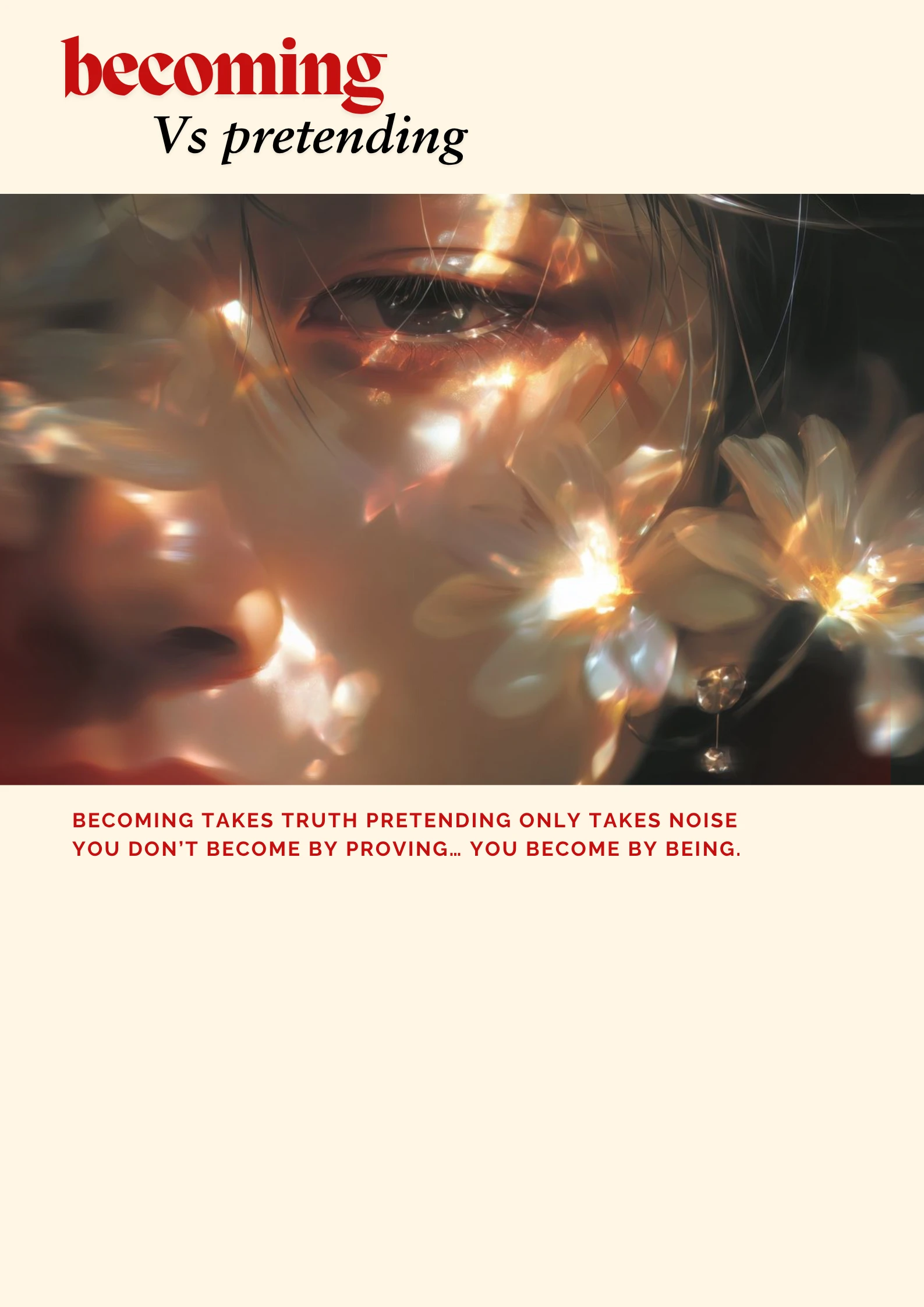
Becoming vs Pretending
April 2026
· 4 min read
In the field of art, it is relatively easy to adopt the appearance of an artist.
One can learn the language, imitate the gestures, reproduce familiar aesthetics, and present work that, at first glance, seems convincing. From the outside, the distinction is not always clear.But the difference between appearing and becoming is fundamental.Pretending is based on control. It relies on what is already known, already accepted, already validated. It is a construction—carefully assembled to resemble something real, yet not rooted in an actual transformation. It seeks recognition before it has developed substance.
Becoming, on the other hand, is a slower and less visible process.It does not aim to produce immediate results, nor to confirm an identity. Instead, it gradually reshapes perception.
The way one sees, decides, and responds to the work begins to change. This shift is often subtle, and for a long time, it may not be noticeable to others.But it is decisive.⚜️ In an academic practice, this distinction is critical.
Because real development does not come from refining an image of oneself as an artist, but from engaging with the process in a way that allows that identity to emerge organically.
Becoming cannot be accelerated by performance.
It cannot be secured through appearance.It requires continuity, attention, and a certain honesty in relation to the work—an ability to see what is actually there, rather than what one wishes to present.Over time, this difference becomes visible.Not through claims or positioning, but through the work itself. There is a clarity, a coherence, a depth that cannot be imitated, because it is not constructed—it is the result of a sustained internal shift.